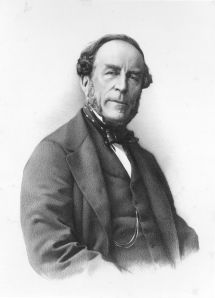
 As soon as he entered government in August 1830, Guizot set about rooting the new regime in the continuity of national history, in order to strengthen its legitimacy. In his eyes, history could be a powerful agent of social cohesion, fuelling a need for collective pride by showing that France had come from very far away. His universally recognised ideas and knowledge as a historian put him in a good position to develop a kind of heritage policy, based on the idea expressed by him as early as 1828 that «it is a serious disorder and a great weakening of a nation to forget and disdain the past». From then on, the management of national memory became a matter for government. The cornerstone of this policy was the creation in October 1830 by Guizot, Minister of the Interior, of the post of Inspector General of Historic Monuments, which had not existed until then, and which was initially entrusted to someone close to him,
 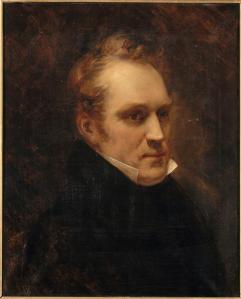 On 27 June 1833, a group of liberal politicians such as Thiers and Molé, historians such as Barante and Mignet, and scholars such as Fauriel and Champollion-Figeac founded the Société de l'histoire de France, with the aim of «popularising the study and appreciation of our national history in a spirit of healthy criticism, and above all through the research and use of original documents». The patronage of the historian and minister Guizot was sought, and his name was placed at the top of the list of founders. He may even have been at the origin of the enterprise, which was intended for a wider audience, since all the texts were accompanied by a translation. During its first twenty-five years, the S.H.F. published 70 volumes, including, from 1841, the five volumes of the trials of Joan of Arc, which are still irreplaceable today. Guizot was president of the Société from 1866 until his death.
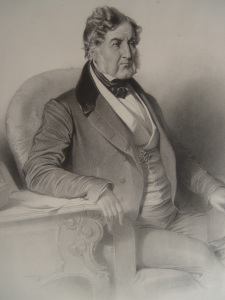 But despite these fine efforts, the S.H.F. was limited by its meagre resources and the voluntary status of its members and collaborators. Guizot decided, and convinced Louis-Philippe and then the members of parliament, that the impetus had to come from above, and mobilise the resources of the State. As early as November 1833, he asked prefects to search public libraries and departmental and communal archives for «manuscripts relating to our national history». A decree of 18 July 1834 set up «a committee under the Minister to direct research and the publication of unpublished documents relating to the history of France». The S.H.F. and other learned societies, first and foremost the Société des Antiquaires de Normandie, were asked to join this initiative. Villemain, vice-president, Daunou, Mignet and Fauriel were among the eleven members of the committee surrounding the minister. Augustin Thierry, who was responsible for managing the collection of charters granted to the communes and medieval guilds that were the source of the French bourgeoisie embodied by the July regime, Michelet, Quinet and also Eugène Sue, were enlisted in the undertaking. Students from the École des Chartes, founded in 1821 and whose activities were revived by Guizot, were mobilised. On 10 January 1835, the Minister set up a second committee tasked with «contributing to the research and publication of unpublished documents on literature, philosophy, the sciences and the arts as they relate to the general history of France». Its vice-chairman, Victor Cousin, was assisted by Mérimée, Victor Hugo and Sainte-Beuve, among others.
When Guizot left the Ministry of Public Education, the pace of inventories and publications, after an impressive start, began to slow. But the Collection of unpublished documents on the history of France will never cease. Thus, as Guizot wrote to Louis-Philippe, «a useful impetus has been given to the serious study of our country's past; a study not only full of attraction, but also likely to elevate the spirit and morality of the nation». For Guizot, scholarly history was also an extension of politics.
The Inspection Générale des Monuments Historiques, the Société de l'Histoire de France, the committee set up in 1834 and renamed the Comité des Travaux Historiques et Scientifiques under Jules Ferry, along with the Collection de Documents Inédits, still exist today and have made a powerful contribution to the preservation and understanding of our national heritage.