[To access the article in pdf format, click here here. To read it online, follow the page navigation].
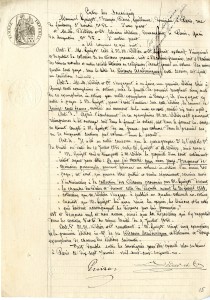
Pierre-Paul Didier committed himself to a substantial sum of 60,000 francs, one third of which was payable on delivery of the texts and the remainder in twenty-four monthly instalments. Warmed by the experience, he gave himself preference for any future collection of political works, as well as for a new edition of the’History of civilisation when Guizot recovered the rights sold to Victor Masson. In fact, he took the initiative, showing a hitherto unsuspected dynamism: probably at the beginning of 1853, Masson transferred to him, under conditions unknown to us, the stocks of the four titles published by the latter between 1849 and 1851, but above all the publishing contract for volumes 1 to 4 of the’History of the Revolution in England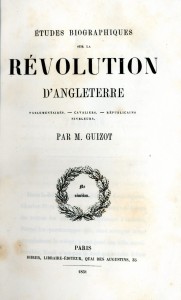 with the consent of the author, who questioned Lenormant beforehand about the exact conditions under which, in 1848, Masson had been preferred to Didier; he was told that his instructions had been scrupulously respected.[2]. The way was now open to resume this major project at 35 quai des Augustins. In the Rue de la Ville-L'Evêque and especially in the Val-Richer, Guizot was now hard at work. Drafts, overloaded with erasures and changes, show that Guizot conducted the negotiations line by line. For his part, Didier was worried by the announcement of a forthcoming publication in the Contemporary review of a fragment of the forthcoming work, as Guizot had done a year earlier with an extract entitled «Cromwell sera-t-il roi?[3]»Was the pre-publication of articles in the press, which Guizot was accustomed to doing and which replaced readings in the salons, an effective promotional tool? The debate is still ongoing. Finally, on 10 May 1853, the author and publisher signed a meticulously detailed agreement. Firstly, the substance of the treaty concluded on 24 November 1848 between Guizot and Masson and the way in which it had been executed was recalled; then the two parties took note of Didier's full and complete substitution for Masson, from which it followed that Didier would publish the third and fourth volumes of the’History of the Revolution in England and will pay the author the 20,000 francs stipulated in the Masson contract. As an exception to this contract, Guizot, «because of the personal regard he has for M. Didier and solely with a view to obliging him» - Didier's self-esteem must once again have suffered from this advantageous position - agreed that payment would be made not in cash on delivery of the entire text, but by the payment of 4,000 francs on delivery of the manuscript of each of volumes 3 and 4, followed by twelve monthly payments of 1,000 francs starting five months after delivery of the manuscript of the last volume. It has been noted that the manuscript for volume 3 has been submitted and the deposit of 4,000 francs has been paid. Thus the persevering Didier resumed a publication that he had taken over in 1840. In fact, the two volumes making up the ’Histoire de la République d'Angleterre et de Cromwell (1649-1658)«, the second part of the History of the Revolution in England, appeared simultaneously in Paris and London in March 1854.
Then began the great manoeuvres for the publication of the sequel to the History begun thirty years earlier. The discussion was extremely bitter, especially as, on 15 October 1855, Guizot was to recover ownership of History of civilisation, which, as we have seen, had been sold to Masson in 1848, and which Didier, on the strength of his preferential right, also coveted. For several weeks, publisher and author fought a tug-of-war from which the latter, in the end, came out rather better off. On 2 February 1855, Didier, in a letter to Génie already mentioned, summed up the grievances he had amassed: crude and unjustified dismissal in 1848 for the’History of the Revolution in England , the scandalous stripping of its rights over the’History of civilisation, costly trial with Brière on The Origins of Representative Government, volume of Biographical studies paid twice, all this called for compensation; then came the time for proposals. Bearing in mind that the offers from other publishers mentioned by Génie showed ’a complete ignorance of the economics of the business«, he offered 10,000 francs for each of the five volumes of the account of the English revolution from 1660 to 1688, plus 5,000 francs for the 1812 history course. But Guizot did not see it that way. Conversations, draft contracts and visits followed one another. Finally, on 14 April, Guizot wrote Didier an official letter, reminding him of the preference clause he had granted him on equal terms, and informing him of the offers he had received from competitors: 40,000 francs for the five volumes of the 3e and 4e parts of the’History of the Revolution in England with a print run of 5,000 copies, and 15,000 francs for each subsequent edition with a print run of 3,000 copies; for the new edition of the five volumes of the’History of civilisation, one franc per in-8° volume and 50 centimes for the in-12° format, with no indication of the print run. Was Didier prepared to go along with this? He was asked to «respond without delay». As a good tactician, the publisher did not reply. He reminded Guizot of their recent conversation «which you seem to have completely forgotten». For the five volumes of La révolution d'Angleterre, the publisher offered 50,000 francs, while the author demanded 60,000, without mentioning the print run, and therefore on a flat-rate basis. To compensate for his setbacks, Guizot offered Didier 1,000 copies of the’History of civilisation Didier asked for 5,000 unpaid copies. As the discussion went on, we agreed on 60,000 francs and Didier lowered his demands to 3,000 copies. Since then, Guizot has remained silent. Didier then refrained from replying to the letter of 14 April, in the hope «that you will reconsider the intention that I observe with sorrow in your new proposal, that of breaking with me».»[4].
Guizot was not the sort of person to strike a chord with. On Sunday 22 April, Guizot demanded that Didier give Génie a yes or no answer the next day on the exercise of the right of preference. In fact, the negotiations lasted all week, and on Saturday 28 April, Guizot became angry: «Let Didier know that everything must be finished. next Monday, before 1 a.m., according to my latest conditions, or by a yes or a no positive (...) I won't change one iota and I won't wait another day». He had to wait a little longer, and on 12 May two separate agreements were signed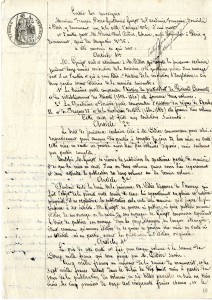 . In the first, Guizot ceded to Didier for twelve years «exclusive enjoyment», «as something belonging to him in full and entire ownership» and of which he «will exploit the publication and sale in the manner he deems most in keeping with his interests», the third and fourth parts of the’History of the Revolution in England together forming five volumes. The unusual formulas used seemed to strengthen the rights of the publisher, who also obtained a preference clause at the end of the assignment period. In reality, the author was well served. Firstly, his rights were reserved for all foreign languages, and not just English as usual. Secondly, the number of author's copies was increased to one hundred. Finally, the price of 12,000 francs per volume, payable 5,000 francs each on submission of the manuscript and the balance in six quarterly instalments following publication, was confirmed.
  It should be noted that the stability of prices and currency at the time allowed payments to be staggered in the form of promissory notes, a formula appreciated by the publisher for cash flow reasons and by the author for the visibility and regularity of his income. The manuscript of the first volume of the third part was finished, and the second was being written. Both were published in February 1856, and shortly afterwards in London by Richard Bentley, 8 New Burlington Street, in a translation by Andrew Scoble that was considered defective.[5]. But the fourth part was never written. The six volumes that now constituted the definitive edition of the’History of the English Revolution were operated continuously by Didier and then by his successor Émile Perrin until 1884.
The second agreement of 12 May 1855 concerned the’History of civilisation in Europe and France, Didier was guaranteed enjoyment of the rights under the same terms as for the other contract, but this time with no time limit. The ’compensation« - an unusual term - due to the author was one franc per in-8° volume and fifty centimes for in-12° volumes, as Guizot had requested in his letter of 15 April, citing a similar proposal. However, the author, »taking into consideration the trouble that may have been caused to M. Didier in the exploitation of his The origins of representative government»gave up its rights to 2,000 in-8° copies of’History of civilisation, This represented 10,000 volumes, and therefore 10,000 francs. Didier, even though he had originally asked for 5,000 copies, hadn't lost everything. 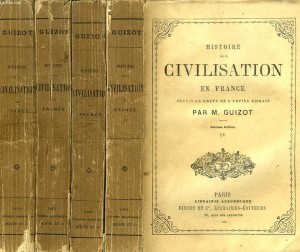 This compensation will be phased in over successive print runs, on the understanding that the publisher will be able to publish the’History of civilisation in Europe and the four volumes of’History of civilisation in France. So, for this sixth and forthcoming edition[6], Guizot only received 2,000 francs. However, he had already made considerable sums from it previously and, as this transfer was remunerated not on a flat-rate basis but according to print runs, he and his heirs would continue to benefit greatly from it for another thirty years or so, due to a success that would only slowly wear off.
After these major publishing operations, which undoubtedly left their mark on both partners, Guizot signed five more contracts with Didier, for works of lesser importance.[7]. Between June and September 1856, Guizot published three issues in the Revue des deux mondes a «study in contemporary history» devoted to Sir Robert Peel, the British Prime Minister when he himself was at the Foreign Office. Even before this publication was finished, Guizot was asked, or made sure he was asked, to edit it in one volume, adding documents that had never been published in France and would therefore have to be translated. Didier prevailed after bitter negotiations, and the agreement signed on 24 July bears the hallmark of this. The text was sold for twelve years at the price of 10,000 francs if it represented at least 125 pages of the Revue, and 480 francs would be added for each additional ten pages, up to a maximum of 185 pages, with 500 francs reimbursed for the translation of documents. The author reserved all foreign rights. The work appeared as follows at the end of 1856[8], the English edition following shortly afterwards[9]. Guizot took advantage of the occasion to engage in an unequal exchange: for the new editions agreed upon, Didier asked him for prefaces «which are not without importance, and which take up my time. I don't want to do a fool's job and take this trouble for absolutely nothing». In return for these prefaces, Didier will have to write off a debt of around 500 francs in book purchases on behalf of the author. «If he doesn't like it, no more prefaces».»[10]. Didier pretended to feel some sorrow: «I confess that I had hoped to owe these two pieces to your good grace alone, but since this receipt must be included, I give it to you, Sir, in its entirety.[11]»Such are the relations between these two gentlemen; literature is a business. The negotiations for a new edition of Complete works based on the old translation by Le Tourneur, revised by Guizot and Amédée Pichot and published in 13 volumes by Ladvocat in 1821. In an unctuous patois whose substance has lost none of its topicality, Didier argues: «Threatened as we are by the competition with which we have to reckon, M. Hachette on the one hand, who is having a translation done, and on the other that of M. Hugo fils, competition that is as much a matter of fact as of fact. Hugo fils, competition that is all the more serious because it is based on cheapness, we find ourselves with the alternative of either printing your translation as it is, or printing it after a revision that you no doubt feel is necessary, a kind of sacrifice imposed by literary competition, a revision on terms commensurate with the situation. (...) Our habits and our taste for the best push us towards a sacrifice that necessity must nevertheless limit.[12]»All this to say that he could offer no more than 4,000 francs for an eight-volume publication. The agreement was signed on 4 December 1858 on this basis, and Guizot set his children to work «revising, having revised and correcting» the original translation «so that it would be accurate and fully satisfactory».»
 The collaboration with Didier was coming to an end. To put an end to it, Guizot, under a contract dated 17 January 1861, granted him the right to publish a collection of his speeches delivered at the Institut, in literary and religious societies and on the occasion of prize-giving ceremonies, adding to them, for good measure, three essays written in 1826, this motley collection under the title of Academic speeches, more honourable than profitable
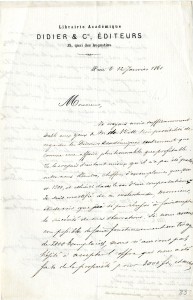 In reality, this modest sum was in compensation for the cancellation of article 2 of the treaty of 10 July 1850, concerning the «Fragment de mémoires personnels» and the Discourses devant les Chambres, the publication of which had been reserved for Didier. This was because, for several years, Guizot had been required by other urgent matters, and solicited by other publishers, to whom he had alluded to raise Didier's bid, and ended up naming: it was, unsurprisingly for Didier, Louis Hachette and Michel Lévy.[14], who had long been lying in ambush. I will deal with the first in the last part of this study, since he was the editor of Guizot's last and most profitable work.
- This is what emerges from a letter from Didier to Génie on 28 April, giving an extract from the deed of assignment granted by Masson.↵
- «M. Masson prevailed over M. Didier in a circumstance where, as your letters testify, you were consulted day after day. Letter from Charles Lenormant, 21 January 1853.↵
- «M. Guizot gives in too easily to the solicitations of MM the journal publishers (...) This will be extremely detrimental to the sale of the two volumes, of which you know that you have to sell a lot to break even; and then there has been no reservation about it, it is, so to speak, a derogation from the treaty, and above all it would be detrimental to me». Letter dated 28 April 1853.↵
- Letter dated 21 April 1855.↵
- Under a contract signed on 11 October 1852 for £125 - £1 = 25.20 francs - Richard Bentley had published the second part, in a truncated version and with the same translator, under the title History of Oliver Cromwell & the English Commonwealth. The third part is entitled History of Richard Cromwell & the Restoration of Charles II. The defective quality of these editions can be explained by Guizot's financial demands, which prevented him from paying a good translator. Cf letter from H. Reeve to A. de Tocqueville dated 30 January 1856, in Alexis de Tocqueville, Complete works, t. VI, vol.1, Paris, Gallimard, 1954, p. 159.↵
- L’History of civilisation in Europe reappeared in 1856, and the’History of civilisation in France the following year, with a new preface for each of the two books.↵
- Missing are those relating to Essays on the history of France, reprinted by Didier in 1857 in a ninth edition with a new preface, and in the Universal dictionary of French synonyms, The fourth edition, published by Payen in 1848, was revised by Victor Figarol, a teacher and close friend of Guillaume Guizot. This fifth edition was published in two volumes in 1861. Four others followed until 1885.↵
- It comprises 358 pages of main text, representing 165 pages of the Review, and 174 pages of documents.↵
- Memoirs of Sir Robert Peel by M. Guizot, Richard Bentley, 1857. The name of the translator does not appear on the title page. This contract had been concluded on 17 June, before the agreement with Didier, for £125.↵
- Letter to Génie, 28 June 1856.↵
- Letter from Didier to Guizot, 14 August 1856.↵
- Idem, 30 October 1858. The eight volumes appeared between 1860 and 1862, and were reprinted three times.↵
- Letter to Guizot dated 12 January 1861 from Désiré Glorian, Didier's first clerk.↵
- On these two personalities and their companies, see Jean-Yves Mollier, Michel and Calmann Lévy or the birth of modern publishing (1836-1891), Paris, Calmann-Lévy, 1984, and Louis Hachette (1800-1864), Paris, Fayard, 1999.↵