[To access the article in pdf format, click here here. To read it online, follow the page navigation].
Michel Lévy was thirty-one years old when, in 1852, he set up 2 bis rue Vivienne, the bookshop founded by his father Simon in 1836 and now a leading publishing house. The file I am presenting and commenting on here contains ten contracts signed with Guizot. Guizot's correspondence and the archives of the Calmann-Lévy publishing house show that Michel Lévy, from at least 1855 and probably earlier, had established a relationship with him and his family that grew closer over time.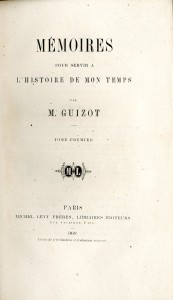 Guizot had never thought of entrusting the publishing of his political works to the latter, who had a literary and historical tradition, which is why it is surprising that he did not take the trouble, and that Didier did not ask him, to cancel article 2 of the 1850 contract earlier. In fact, this was the project that Guizot had decided to tackle as early as 1854, referring indefinitely the drafting of the fourth part of the’History of the Revolution in England. A first contract, for a volume on the origins and effects of religious freedom in Christian Europe, was signed on 21 March 1857 with «Messieurs Michel Lévy, frères», as Michel also represented his older brother Calmann, who was more in the background, but was not followed up. The big deal came three days later, in the form of an agreement with a very simple structure but very substantial content. Guizot ceded ownership of his books to Calmann for twelve years from the date the last volume went on sale. Memoirs to serve the history of my time, The manuscript for each volume was to be submitted from 1858 onwards «so that the work could be completed by 1862 at the latest», i.e. at least one a year. The fixed price was set at 20,000 francs per volume for the first three, 12,000 for the fourth, and the same for a fifth «if the work contained too much material to fit into four volumes». Half of the sum due would be paid in cash on delivery of the manuscript, and the balance in two notes payable three and six months after delivery of the final sheet of the volume concerned. The English language rights were reserved for the author. This did not include the £1,200, or nearly 25,000 francs, to which Richard Bentley had committed himself under contracts dated 1 January 2008.er May 1857 and 8 May 1860[2], At least 72,000 francs, an unprecedented sum for him, Guizot could expect from this Herculean task, which at the age of 70 he was embarking on with a light heart.
And the old athlete rose to the challenge, publishing five volumes in succession by 1862. And yet he had only reached the beginning of 1840. Three volumes were still needed. Although a new contract was signed with Michel Lévy, it does not appear in the file. But assuming that these last three volumes were paid for in the same way as the fourth and fifth, Guizot would have made a total of 120,000 francs from this major undertaking. A break was in order. Under a contract dated 21 March 1861, Guizot sold to Lévy, under the ambitious and excessive title of’Parliamentary history of France, Guizot was granted the right to publish his Speeches to the Houses, in four volumes to complement the Memoirs. Guizot undertook to provide linking texts that would «give, so to speak, the thread of the history of the parliamentary regime during the government of King Louis-Philippe». The first volume will contain an unpublished introduction of between one hundred and two hundred pages, entitled - although the contract does not specify this - «Three generations, 1789, 1814, 1848».»[3]. The agreed sum is 4,000 francs per volume, payable on the same terms as the Mémoires. Under a new profit-sharing clause, a «bonus» of 1,000 francs per volume will be paid as soon as sales - and not the print run - exceed 3,000 copies. It was specified that if one or more additional volumes proved necessary, they would not be paid for. In this way, the publisher saved at least 4,000 francs, because a fifth volume was indeed needed, the whole being published in 1863-1864. Publication of the Memoirs could resume, and was completed in 1867. In ten years, thirteen volumes had been published.
In the meantime, Guizot had not remained inert, actively turning his attention to religious questions. On 24 August 1861, he granted M. Lévy the rights to a work entitled The Church and Christian society in 1861. The manuscript, which Guizot had in fact started writing in May, was due to be submitted two weeks later, and indeed it was. The price was set at 1 franc 25 per in-8° volume and 50 centimes for the in-18° format. 10,000 francs will be paid for a first print run of 8,000 copies, half in cash on delivery of the manuscript and half at three and six months. It is specified that «double passes customary in bookshops» will not be paid for, but it is implicit in article 6 on payment that they are not counted in the print run. The publisher will be able to publish the work in Germany - i.e. in French - without owing anything to the author, to whom are reserved, as usual, the English language rights, the others belonging to Lévy. On 7 December 1863, a contract for a volume of Meditations on the Christian religion, The fee was increased from 1 franc 25 to 1 franc 50 if the volume was longer than 400 pages, and a right to continue with other Meditations on the same terms. In fact, two volumes followed the first, published in mid-1864[5], A total of four substantial works, all from the pen of Guizot alone. And that was not all: by contracts dated 20 February 1868 and 15 March 1869, and on identical terms - 4,000 francs half in cash half in three and six months' time - Mr Lévy acquired ownership of two collections of articles, the content of which was not specified, respectively Biographical and literary mixtures and Political and historical mixtures[6], each with an unpublished preface. Lastly, under three Lévy contracts dated 24 March 1857, 25 January 1860 and 8 June 1861 respectively, ten volumes translated under the auspices of Guizot were published, each containing for each work[7] a preface by him of at least 32 pages, for prices totalling 10,000 francs. For Michel Lévy as for François Guizot, but for different reasons, this decade of 1858-1869 was a publishing prodigy, because of the enormous mass of texts provided.[8] and by the no less considerable sum by which they had been remunerated during this period, since Guizot had received at least 200,000 francs for the French language alone, or perhaps, but any conversion is very risky, about a million euros. This created links in both directions, and the trust between Michel Lévy and Guizot never wavered, even though Guizot relied on Hachette for his most recent works.
- From the summer of 1867 onwards, Mr Lévy addressed «dear Monsieur Guizot», rather than «Monsieur» alone, expressing his «most affectionate and devoted feelings», and remembering «the good people of Val-Richer».↵
- Memoirs to illustrate the history of my time. Translation by John William Cole.↵
- In 1863, M. Lévy published a separate edition of this introduction in an in-18° format at the same time as the first three in-8° volumes of the Discourses.↵
- Article 2 states that the composition will use «the same justification as the edition of Mr Renan's translation of the Song of Songs, published by Messrs Michel Lévy frères». Guizot rarely stuck to Renan.↵
- After the Meditations on the essence of the Christian religion (1864) were published Meditations on the present state of the Christian religion (1866) and Meditations on the Christian religion in its relation to the present state of societies and minds (1868).↵
- The first collection contains notes of very unequal length on Édouard Gibbon, Mme de Rumford, Mme Récamier, the Comtesse de Boigne, the Princesse de Lieven, M. de Barante, M. de Daunant, Philippe II and his new historians. The second collection contains six essays and articles published between 1816 and 1828.↵
- History of the foundation of the Republic of the United Provinces by John Motley, 4 vols, 1859-1860 ; China and Japan by Lawrence Oliphant, 2 vols, 1860 ; William Pitt and his time by Lord Stanhope, 4 vols, 1862-1863. To this must be added, in application of a contract unknown to us, Prince Albert, his character, his speeches, in a translation by Henriette de Witt, preceded by an important preface by Guizot, in 1863.↵
- We must add a foreword to a new edition of The genius of Christianity de Chateaubriand, in two volumes, by M. Lévy in 1866, and a short work taken from a long article published in September 1869 in the Revue des deux-mondes, France and Prussia answerable to Europe, 5000 copies, each paid 15 centimes.↵