[To access the article in pdf format, click here here. To read it online, follow the page navigation].
In the face of this tidal wave, the book that resulted from the last contract signed by Guizot on 13 April 1872 may seem insignificant. But it was not insignificant to its author, who organised its publication in an original way. He had received a very long and surprising letter dated 10 June 1867 from Alexander Mac Millan , In 1843, together with his brother Daniel, grandfather of Prime Minister Harold Mac Millan, he founded a publishing house at 16 Bedford Street, Covent Garden. In this letter, Mr Mac Millan, who was now the sole director of the company, gave a long personal account of himself: his origin and strong Scottish identity, his mother's piety, the death of his excellent father when he was seven, his upbringing in accordance with the traditions of his country, with a respect for the rule of law, and the fact that he had been born in Scotland. sabbatte day, the edifying Sunday readings, in particular The Pilgrim's Progress of John Bunyan, his schooling in Glasgow, his beginnings in London with his brother Daniel, a bookseller's clerk, and their setting up on their own. After this interminable captatio benevolentiae, But he was getting down to the nitty-gritty: obtaining Guizot's collaboration on a series of books for Sunday reading, entitled «Sunday Library of the Households», whose spiritual influence on the public would be enhanced by an attractive presentation and the names of distinguished writers. His recruits included Charles Kingsley, Thomas Hughes, author of the famous The Brown's School Days, and, more appropriately, Charlotte Yonge, revealed by her short story The Heir of Redcliffe, and Dinah Craik, who won acclaim for John Halifax, gentleman, whose husband George was Mac Millan's partner. In fact, these two novelists of unsuspected morality had become friends of Henriette de Witt, who had translated and would continue to translate some of their works into French.
 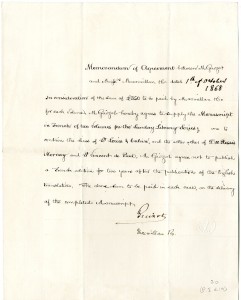 they were received regularly at the Guizots' home, including at Val-Richer. The very next day, Frances Martin, Mac Millan's editorial collaborator, took over, proposing that Guizot write the lives of Saint Louis, Saint Dominique and Saint François. The last two were hardly suitable for Guizot, and they agreed on Saint Louis and Calvin, Duplessis-Mornay and Saint Vincent de Paul, two Catholics and two Protestants. A Memorandum of Agreement was signed on 1 October 1868, under which Mac Millan would pay £350 for each of the two volumes containing the lives of Saint Louis and Calvin, and those of Duplessis-Mornay and Saint Vincent de Paul, on delivery of each of the two manuscripts written in French.
 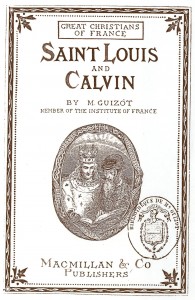 The author undertook not to publish the French edition within two years of its publication in English. By the time the contract was signed, the writing of the first volume was well advanced, so that in January 1869 the final manuscript of the first volume was in the hands of Mrs Frances Martin, who was responsible for the translation, which Guizot checked as he went along, and then on proofs. Their intensive collaboration, which took the form of assiduous correspondence, led to the publication at the end of the year of Great Christians of France. Saint Louis & Calvin, by M. Guizot. Who dismissed indefinitely the production of the second volume.
In the spring of 1872, the two years of English exclusivity having expired, Guizot asked Templier if Hachette would be interested in a French edition. The offer was immediately accepted, and a contract signed on 13 April by Guizot and Georges Hachette, covering The Lives of Four Great French Christians, This was to be published in two volumes, each paying one franc per copy for the in-8° format, sold for 7 francs 50, with an initial print run of 1,500, and fifty centimes for the in-18° Jesus format, sold for 3 francs 50 and with a subsequent print run of 4,000 copies. The publisher reserved the right to publish each biography separately, with an initial print run of at least 5,000 copies at 15 centimes each. Guizot pointed out that a translation of the first volume had already appeared in English, and that he reserved the right to publish the sequel in the same language, before publication in French and for his exclusive benefit. Finally, the manuscript of the first volume was to be handed in on 1er July, proof that Guizot wanted to modify and adapt his text for the French public. The 376-page in-8° edition, with a short preface, appeared at the beginning of 1873. It does not appear that another edition was ever made.
 Thus ended, with Guizot's life itself, his activities as an author. The publishers believed in his eternity, since on 25 April 1874, less than five months before his death, the Boston firm of Estes & Lauriat, having heard that he was preparing a «Histoire universelle» - no less -, again put itself forward as a candidate for its English edition. This project existed only in the minds of these gentlemen, but it bore witness to the influence of one of the most renowned authors of the century. From the 1808 treaty with Maradan to the 1872 contract with Hachette, a whole world had revolved around an intellectually unsinkable Guizot. From copies paid for on a flat-rate basis to per-copy remuneration based on the print run, from payment in gold coins to cheques drawn on a London bank, from the appearance of the pass and advertising to the distribution of the proceeds of foreign rights, from high-price publishing to very cheap books and sales in deliveries, from food work to masterpieces fiercely negotiated, from the shop of the bookseller Brière to the Hachette company with nearly 400 employees and ten million in capital, Guizot, in sixty-four years, had seen the publishing profession develop and transform, contributing in his own way to it both through his material requirements, his understanding of the publishing business and the immensity and quality of his writings. He lived publishing as he made it live.
Laurent THEIS