[To access the article in pdf format, click here here. To read it online, follow the page navigation].
The 1er On 1 January 1839, Guizot signed a contract in two short articles granting Didier the right to publish his Modern history course of 1828-1830, in other words its History of civilisation. The proceeds would amount to 7,200 francs, payable in six instalments of 1,200 francs between 1839 and 1844: an old-fashioned agreement, in short, but a rather lucrative one. It is true that this course was to be reprinted at least nineteen times in the nineteenth century, until 1882, by Didier and then his successor Émile Perrin. This was not the beginning, but a stage in a collaboration that lasted nearly thirty-five years. Born in 1800, Pierre-Paul Didier had founded an academic bookshop in Paris in 1828, mainly to publish the lectures of professors at the Faculté des Lettres. Together with Jean-Armand Pichon, who had been licensed as a bookseller in 1827, he took over from François Béchet Aîné and published a first edition of the Modern history course in six volumes between 1829 and 1832, as well as a reprint of  The death penalty in political matters in 1828. It was then, at the latest, that Guizot met him. Since 1832, he had been publishing under his own name and on his own account, at 35 quai des Augustins. On 7 February 1840, in the same spirit as the contract of the previous year, Didier acquired for four years the right to reprint what was already a reference work in France and England, the two volumes of the’History of the English Revolution, In addition to the fight against Belgian counterfeiting, a preference clause was explicitly included. In addition to the explicit aim of combating Belgian counterfeiting, there was a preference clause: at the end of the four-year period, and «at an equal price», Didier would be preferred to any competitor, not only to reprint these two volumes, but also to publish their sequel, which promised to be substantial since Guizot had from the outset made known his intention to continue his account until 1688. This agreement, which takes up twenty-five lines and is signed as if in passing, was later to contribute greatly to the deterioration of relations between Didier and Guizot.
In the meantime, the latter had embarked on an adventure whose outcome was not to be very glorious. Approached by the solicitor Gabriel Bodiment, who, like others, had declared his admiration for him, on 22 November 1839 he concluded two treaties with him, even though he was not a real book professional. The first was for three volumes of Historical and political mixtures, to be submitted within one year. Bodiment acquired the publication rights for four years, at a price of 4,000 francs per volume, payable on submission of the manuscript, and for a print run of 3,500 copies, after deducting - and this was a new feature - the «mains de passe», i.e. the manufacturing deficits. A complicated system of forfeiture and reimbursement in the event of failure to meet the agreed deadline, covering all or part of the entire work, showed that the two contracting parties were not assured of the successful completion of the project. Similar clauses appeared in the second, even more ambitious treaty: as Mr Guizot had «expressed his intention to write a history of Mirabeau», Bodiment acquired the publication rights to this volume, which was to be delivered within two years. If the author decided to continue his work in the form of a history of the Constituent Assembly in two, three or four volumes, this time to be delivered within four years, and «perhaps even later the history of the Convention and the Directoire», Bodiment would purchase the rights under the same conditions. He committed himself to a print run of 17,000 copies, justified at the author's request - one can never be too careful - by a declaration signed by the printer, and each volume was paid 20,000 francs, a considerable sum, a little too good to be true perhaps, hence the luxury of precautions in the event of delays. Bodiment, unable to finance such an operation, joined forces on 25 November with the young banker - he was 31 - Mariano de Bertodano, a handsome knight of industry whose activities included managing the Compagnie Corse, which exploited the island's forests. He was to provide the necessary capital, up to a limit of 60,000 francs, with Bodiment taking care of the publication. The exorbitant commitments made by Guizot, who returned to the government a year later, were naturally not kept, since he only handed over the manuscript of half of the first volume of the Mixes, The affair went badly wrong, especially as Bodiment died in 1840. In 1843, after tough negotiations, Guizot was forced to reimburse Bertodano 5,400 francs that he had received in December 1839 and January 1840 as an advance payment, which the contract did not provide for, and to pay him 2,866 francs as compensation for the cost of purchasing paper and printing. On 18 March 1844, an agreement was reached between the two parties to settle all accounts. The author, minister though he was, and no doubt anxious not to publicise the affair, had not had the last word.
On 24 February 1848, the revolution made Guizot an exile in England. Having left empty-handed and settled with his family at 21 Pelham Crescent in Brompton, then a suburb of London, he felt a pressing need for money, which could only be provided by his writing. He immediately resumed his work, in particular the’History of the English Revolution, of which he recovered in 1845, for the first two volumes, the rights held by Didier under the terms of the 1840 agreement, and also the’History of civilisation, which Didier continued to publish regularly, with reprints in 1845 and 1846, and which Guizot intended to follow up. As far as can be reconstructed, he instructed his faithful friend Charles Lenormant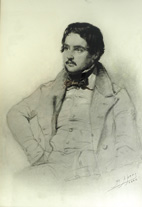 to find him a publisher in France who would give him the best terms. Lenormant, at Guizot's request, began by approaching Pierre-Paul Didier, whom he felt was not strong enough to provide Guizot with the large sums of money he was claiming. The conversation between the two men went badly, and Didier later claimed that Lenormant had been insulting, «treating him like a little boy, a poor devil who couldn't give 50,000 francs in cash in 1848".[1]. » This very high amount, Lenormant claimed, was the one proposed in writing by a competitor reputed to be more dynamic, Masson. Born in 1807, Victor Masson had been hired as a clerk by Louis Hachette in 1833. After forming a partnership with the bookseller Nicolas Crochard to run the Librairie médicale et scientifique, he set up his own business in his own name in 1846, at 17 place de l'École de Médecine, and, while designating himself as «Bookseller to the learned societies of the Ministry of Public Instruction», sought to expand his catalogue. Guizot would be a choice recruit for him, and so Charles Lenormant directed his «illustrious friend» to him, who directly negotiated the terms of a contract signed on 24 November 1848 in Brompton, where Masson seems to have gone on purpose.
This eleven-article document is of the greatest interest, as its clauses have clearly been weighed with a trebuchet. While the financial terms granted to Guizot are unprecedented, the publisher has surrounded them with hitherto unknown precautions. In addition, there were new elements compared with the contracts we have: the author's first print run on vellum was 25 copies, and above all the author retained all the rights for the English language, on the understanding that this foreign edition «may not appear a single day before the publication of the French-language edition»; this reservation of English-language rights would henceforth appear on all the contracts signed by Guizot, who considered himself, through his many connections across the Channel, to be in the best position to assert his interests. In fact, his major works, and even others, were translated into English within a short space of time, and were sometimes very successful in the book trade, generating substantial income that the author did not wish to share with the French publisher. Finally, and this article will often be found in later agreements, the transfer of rights granted by the author to the publisher cannot prevent the texts concerned from being included in any future Complete Works, provided that they are not presented separately and that a certain period of time is respected. Guizot therefore sold Masson the exploitation rights for the first period of 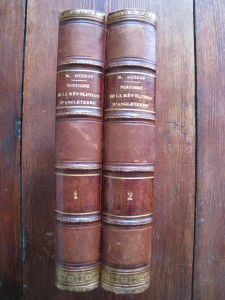 l’History of the English Revolution (1625-1649), already published by Didier, with an unpublished introduction to be submitted «as soon as possible», and the second period (1649-1660), which Guizot intended to write and deliver by 15 July 1850 at the latest. If he wrote the third period (1660-1688), Masson would benefit from the preference clause. As the price for this transfer, the author would receive 20,000 francs on delivery of the introduction, and the same amount on delivery of the second period. Victor Masson had therefore committed himself to 40,000 francs, and not 50,000 as Lenormant would have told Didier; even so, he had nothing to pay immediately. Did he suspect that Guizot, who was not ruling out the idea and even the hope of returning to politics, would not respect the timetable set? In any case, he was well placed to do so, since on 21 December 1848 he signed a contract with his new author granting him ownership of a political essay of 130 to 150 pages, entitled Democracy in France
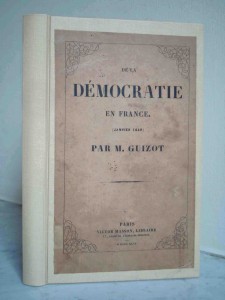 . January 1849. Guizot was then putting the finishing touches to this highly ideological work, of which he had promised himself a great deal, which was published the following January and sold over 20,000 copies in a few weeks. Despite the Shakespearian self-congratulation of the publisher - «My conscience tells me that I had made suitable offers, but when it comes to being or not being the publisher of M. Guizot, I cannot hesitate....[2]»This hastily concluded agreement did not come cheaply. Guizot had found himself delayed in his main work, as Masson had foreseen, and indeed Guizot himself. The latter had in fact agreed that, if the manuscript of the second period was not handed in by 15 July 1850, the publisher «would be invested, from that day on and without the need for formal notice, with the right to publish an edition of the’History of civilisation as published by the bookseller Didier in five volumes», in six thousand copies, and without producing any royalties, «as compensation for the prejudice caused to him by the delay» in delivering the manuscript. He was granted this right until October 1855. Finally, if the manuscript of the second period was never delivered to him, in the knowledge that Guizot did not have the right to present it to another publisher at any time whatsoever, Masson «would find himself invested with absolute and unlimited ownership of the history of the first period», and not just for twelve years. The leonine nature of these articles 8 to 10 was exorbitant, and if Guizot accepted them, it was either because he was really short of money, or because he imagined that he would soon regain his seat as a member of parliament and perhaps even better, or because he was presuming on his strength, which was nonetheless great. Pierre-Paul Didier, who was to bear the cost of the planned compensation even though he had up to then fulfilled his commitments, later complained bitterly about the procedure of which he had been the victim, and claimed that Guizot had allowed himself to be conned by the enterprising Victor Masson. It is true that he himself had omitted, «inadvertently» he said, to include in the 1839 contract relating to the’History of civilisation a preference clause which he said was self-evident in his mind, since the modern history course «was like a child to me, and it never occurred to me to part with it".[3]. »
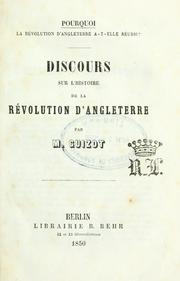 It happened just as Masson had predicted. On 26 January 1850, he published the fourth edition of the two volumes of the first part, preceded by an introduction entitled Why did the English Revolution succeed? Discourse on the history of the English Revolution. Masson also published a separate 180-page edition of this magnificent text, perhaps the most complete and dense ever written by Guizot, which was immediately translated by Sarah Austin, a very close friend of Guizot, and published shortly afterwards in London by John Murray. Once again, it was a resounding success. But 15 July was approaching, and the manuscript of the second period had barely begun. Masson was adamant: in 1851, by way of «compensation», he published the five volumes of the’History of civilisation. In three years, he had pulled off a superb triple coup, actually spending only 24,000 francs. Guizot had fared less well. He never did business with Victor Masson again.