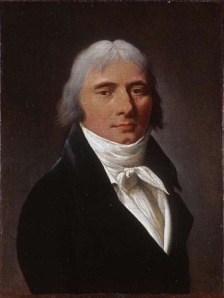
 It was in 1812 that François Guizot met Pierre-Paul Royer-Collard, whose name, too often forgotten today, was one of the most important during the period of the constitutional monarchy, to which all his intellectual and political activities are linked.
By then he was 49 and already had a wealth of experience: a lawyer at the Paris Parliament at the end of the Ancien Régime, he enthusiastically rallied to the Revolution and, close to Danton for a time, served the Paris Commune. After escaping the Terror, he became a deputy to the Five Hundred in 1797, and joined the Bourbon Legitimists after the coup d'état of Fructidor. He was then a member of the small secret council that tried to open the eyes of the future Louis XVIII to the new realities. From 1803 onwards, he shut himself away in literary and philosophical meditation. His friend Fontanes, Grand Master of the University, nevertheless convinced him to take up the chair of history of modern philosophy at the Faculty of Letters in Paris in 1811. The following year, he received a new colleague, twenty-four years younger, appointed professor of modern history by the same Fontanes.
It was love at first sight between them. Raised by a demanding and revered mother, both from middle-class backgrounds and committed to civil equality, the elder Guizot, steeped in Jansenist tradition and morality, found in the younger a Protestant austerity tempered by impressive sociability and hard work. Guizot, for his part, became attached to this mentor, a former lawyer and Girondist, who could be seen as a surrogate father at the dawn of his intellectual life. In fact, Royer-Collard, the father of two daughters and perhaps in need of a son, immediately took him under his wing, anchoring him in his spiritualist convictions and making him forever prefer Bossuet to Voltaire. He also instilled in him an absolute rejection of the primacy of force over law and of the power of numbers over the truths of reason. Finally, he admitted him to his philosophical circle, which also included Maine de Biran and Victor Cousin, with whom he formed a close bond.
In May 1814, Royer-Collard, who had been appointed Director General of the Librairie, asked Abbé de Montesquiou, Minister of the Interior under the first Restoration, to appoint Guizot as General Secretary. This service partly determined his career. During the Hundred Days, Royer-Collard suggested to the members of the circle of constitutional monarchists that he led that Guizot be sent to Ghent to counter the influence of the ultra-legitimists on the exiled Louis XVIII. This trip had serious consequences for the young emissary. In the group of «doctrinaires» formed at the end of 1817, Royer-Collard, deputy for the Marne, was the leader, to the extent that, according to one tradition, this name came from the fact that he had once followed the teaching of the Fathers of Christian doctrine. Guizot was closely associated with him, and it was together that they drafted reports, bills and speeches under the Richelieu and then Decazes ministries, in support of a liberal interpretation of the Charter.
In 1820, after the assassination of the Duc de Berry and the fall of Decazes, they were both dismissed from the Conseil d'État, and from then on they were sometimes fierce opponents. In January 1830, Royer-Collard president of the Chamber of Deputies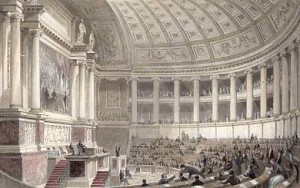 helped elect Guizot in Calvados. The deputy for the Marne, an atypical and solitary conservative and oracle of liberalism, took note of the need for the July revolution without pleasure, and only intervened on occasions when he felt that freedoms, particularly those of the press, were at stake. This was the case in August/September 1835, when he confronted Guizot, spokesman for the cabinet, just as he criticised him in 1839 for his role in the famous coalition against Molé. In 1834, this political dispute had been coupled with a personal quarrel, Guizot having failed to obtain for the husband of one of his nieces «a considerable promotion in the senior administration». A few days later,« he says, »M. Royer-Collard formally expressed to me, in a few bitter and sad lines, his desire to break off our old relations. This distancing was not the first of its kind, for Royer-Collard, a very touchy and shy man with a sharp tongue, had more than once uttered sarcastic words about the ambition of a protégé who had become too quickly and too well emancipated.
But between them, friendship was to remain the strongest. It had manifested itself a great deal during the Restoration, the period of their greatest intimacy, in particular on the death of Pauline de Meulan, and in 1833, after Eliza had given birth to Guillaume, it was Royer-Collard who, having visited her, attentively warned Guizot of her fragile state, foreshadowing a possible death, which indeed occurred a few days later. Madame Guizot's mother had long had an admiring attachment to him, which he reciprocated.
As early as 1830, Guizot recruited Hippolyte Royer-Collard, his nephew, as head of the Science Division at the Ministry of the Interior, and Royer-Collard's son-in-law, the famous doctor Gabriel Andral, was frequently consulted by the Guizot family. The last exchanges between Royer-Collard, who had retired from active politics in 1839, and Guizot, then at the height of his power, were marked by a tenderness that Royer-Collard rarely expressed. In March 1844, Royer-Collard wrote: «In reading you, I feel that there is something indelible between us», and Guizot immediately replied: «I have always known and felt that there was something indelible between us. Yours sincerely».»
When Royer-Collard died on 4 September 1845, Guizot wrote to his widow Augustine de Châteaubrun: «I loved him as I always had. We parted tenderly. I will enjoy it all my life. My mother really loved him. He paid this rare tribute to the Princesse de Lieven: »She was a rare and charming spirit, with a very noble character. Four people have had a real influence on me, on what I can be, become and do. He is one of them. The only man. And to his daughter Henriette: «He did much more than help me with my career. He really contributed to my inner and personal development. He opened up perspectives and taught me truths that, without him, I might never have known. At Val-Richer, in his small study, Guizot hung Royer-Collard's portrait among those of the people he loved.