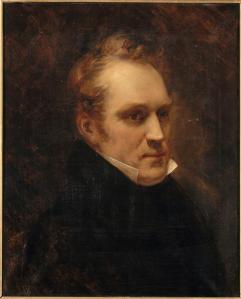
 «I will not end these pages without naming the friends I have left. I want them to know how sweet their friendship has been to me, and that they will not forget me when I am no more. I therefore ask that this testimony be passed on to the Duc de Broglie and to M. Guizot. Guizot inserted this passage from the will of Prosper de Barante, who died in 1866, in the frame of his friend's photograph, which hung prominently in his study at Val-Richer, not far from that of Victor de Broglie. This friendship dated back fifty years and more and, although not completely intimate, remained intact without a cloud in sight. Guizot once wrote, in 1865, that there was »a little jealousy« involved. He was pleased, because Barante's esteem and admiration for him were simply recognition of his intellectual and political superiority. He himself did not aspire to the exercise of power, although he had the means to do so: a choice that Guizot found difficult to conceive.
Prosper Brugière, Baron de Barante by imperial decree renewed during the Restoration, was born in 1782 into an old bourgeois family from Auvergne - the Barante estate is not far from Thiers - and had begun a promising career at a very young age. His father Claude-Ignace, imprisoned during the Terror from which Thermidor had narrowly saved him, and appointed prefect at the very beginning of the Consulate, had paved the way for him. An auditor at the Conseil d'État in 1806, Prosper became sub-prefect of Bressuire the following year, then prefect of Loire-Inférieure in 1809, at the age of 26. In March 1815, at the time of the Hundred Days, he resigned and returned to a position that had always been his, that of a constitutional monarchist. A few months later, he was appointed Secretary General of the Ministry of the Interior, a post that under the 1re The Restoration had occupied Guizot, who became his counterpart at the Ministry of Justice. It was then that they really got to know each other.
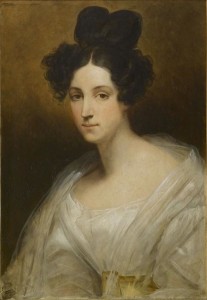 Perhaps they had realised it earlier. In 1811, Barante had married the beautiful and pious Césarine d'Houdetot, granddaughter of Rousseau's friend whose salon Guizot frequented at the time. This was the official end of Prosper's troubled youth. In 1804, while his father was Prefect of Geneva, he met Germaine de Staël and fell in love with her to the point of wanting to marry her, to his father's fury: «Everything is believable, everything is possible, in the horrible madness to which this woman has led you», he wrote to her in 1806. Failing that, he turned his attention to Juliette Récamier. Rémusat recounts: «He was in love with Mme Récamier to the point of asking her for a divorce; he wanted to marry her. He was unhappy.
 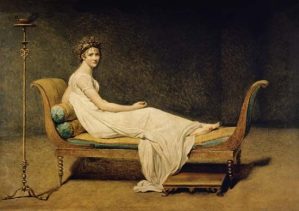 One evening, Mme de Staël, full of compassion and sympathy, after having lavished consolation on him, found that there was no better consolation than to make him sleep with her immediately. I got that from him. The two women remained his friends, as did, tenderly, the Duchesse de Broglie and especially the Duchesse de Dino, although it is not known exactly how far he went with her. He and Guizot had one thing in common: they both appealed to great ladies, sometimes the same ones, mainly through the charm of their conversation. Barante's was said to be incomparable. He was also a handsome man for a long time.
Under the Restoration, Barante and Guizot had parallel careers, except that the former was a member of parliament in 1815-1816, and then sat in the Chamber of Peers from 1819. State councillors and senior civil servants, they supported the liberal policies of the first ministries, forming in 1817 the core of the doctrinaires, under the leadership of Royer-Collard, to whom Barante would much later devote an entire book in two volumes. In 1820, both were dismissed from the Conseil d'État, and devoted themselves to literature and history, Barante publishing a translation of Schiller's works and then a monumental History of the Dukes of Burgundy of the House of Valois which won him the Académie française in 1828. Each wrote flattering reviews of the other's works in the press, and when in 1828 Guizot founded the French magazine, Barante was one of its most active collaborators. In short, they were in perfect harmony of thought and action. 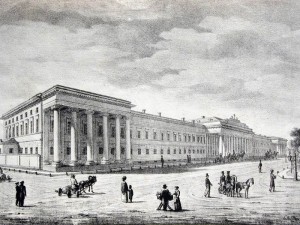 They remained so under the July monarchy, which made Barante ambassador to Turin and then, in 1835, to St Petersburg. When Guizot took over as Minister of Foreign Affairs in October 1840, Barante wrote to him: «My dear friend, here I am under your command, and I shall find myself in official correspondence with you, after having seen our intimate correspondence cease with regret». It soon resumed, because in 1842 a diplomatic incident with Russia meant that Barante did not return to his post, which he held until 1848. As President of the General Council of the Puy-de-Dôme, Barante often lived with him, and «he was for me,» wrote Guizot, «a spectator from a distance, clear-sighted, judicious, cool-headed, and his correspondence alternately brought me wise concerns or affectionate encouragement». For example, he criticised his friend's behaviour during the coalition of 1838-1839, and in September 1847 expressed his concern to him about "this care for private interests, these distributions of favours and jobs, and above all this weakness for the demands of the deputies which were more or less necessary to compose a majority". For Prosper de Barante was, in all things, of high moral character, and truly liberal. Guizot sought his advice without always following it, and looked after the careers of his sons, making the eldest, Prosper, a sub-prefect of Boussac and then a prefect of the Ardèche, and the youngest, Ernest, an embassy secretary in Dresden. This young man caused his parents a great deal of trouble, even suffering, as Guizot told his daughter Henriette, from fits of raving madness that necessitated his internment and hastened his death in 1859. Barante and Guizot shared a strong sense of family.
The Revolution of 1848 led to his immediate and definitive departure from public affairs. Neither the Republic nor the Second Empire succeeded in attracting him. He settled down with the admirable Césarine in a studious retirement, sociable and charitable, often in Barante, doing good around him, not very assiduous at the Académie and the Société de l'Histoire de France, which he had chaired at Guizot's instigation since its creation in 1833. The friendship between them, who frequently dined at each other's homes or elsewhere when they were in Paris, not only never wavered, but was almost tenderised. On the death of the Princess de Lieven in 1857, Guizot wrote to Barante: «My dear friend, if you were here, you might be the person I would most like to talk to»... The last two published letters Barante wrote and received were to and from Guizot in June 1866. He died in November. The following year, Guizot published a considerable obituary of his friend in the Revue des Deux Mondes, in his Biographical mixtures of 1868, and declared before the general assembly of the Société de l'Histoire de France, which he had succeeded as president: «It is a rare happiness to have a friendship that is persistent and unchanging, when everything around it falters and changes. And the sources of the friendship that united us, M. de Barante and I, are those whose traces one delights in finding, at every step, in the long course of the years: a constant and intimate analogy has existed in our tastes and our work, in our ideas and our careers. We have both seriously loved and served literature and public affairs.»
The correspondence between Guizot and Barante was partially published in the eight volumes of the Memories of Baron de Barante, published between 1890 and 1901 by his grandson Claude. These 171 letters are a superb document.