1. Public education
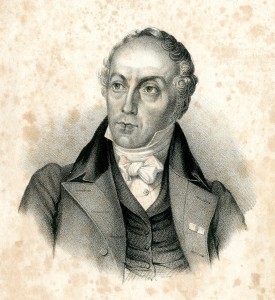
Guizot will thus remain Minister of’Public education He had no rivals in this position throughout the 19th century, and even later, with the exception of Jules Ferry. His greatest legacy to posterity is the law of 28 June 1833, which laid the foundations for public primary education, with the obligation to open a school in every commune and a teacher training college in every département, and the creation of the primary school inspectorate. Guizot also gave considerable impetus to historical studies and to the development of the national heritage. This splendid period in his political life was overshadowed by personal misfortunes. In March 1833, he lost his second wife Eliza Dillon , and on 15 February 1837, at the age of 21, the son he had had with Pauline de Meulan, François, In August 1836, he purchased the estate of Val-Richer, in his constituency of Lisieux. On 15 April 1837, Guizot left the cabinet due to disagreement and growing rivalry with his leader Mathieu Molé, against whom he soon led a parliamentary guerrilla war within an unnatural coalition comprising Adolphe Thiers, from the centre-left, and Odilon Barrot, from the dynastic left.
2. Foreign affairs
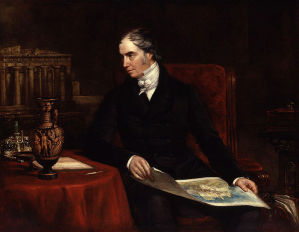 Guizot had become a nuisance and in February 1840 he was appointed ambassador to London, where he made a strong impression but was unable to prevent France from becoming diplomatically isolated in the Turkish crisis that was raging at the time. Thiers, then President of the Council, was judged by the King to be too warmongering towards England, and was replaced by Marshal Soult at the head of a clearly conservative cabinet in which Guizot was given the Foreign Affairs portfolio and was in fact the main minister, due to his powerful abilities and also his exceptional talent for oratory. He held this portfolio for 88 months in a row, a record unmatched to this day in this position. Order and prosperity within and peace without were the pillars of his policy, in full agreement with Louis-Philippe, who felt understood and protected by this tireless and unwavering minister, even in his conservatism. Between 1841 and 1846, thanks to the friendship he had forged with his colleague Aberdeen, he established a «friendship" with England, France's main rival in Europe.
 The replacement, in July 1846, of Aberdeen by Palmerston, who was hostile to France in general and to Guizot in particular, put an end to this entente, and the Spanish marriage affair, which was a success for the French minister at the expense of England, caused great tension between the two countries. Guizot then seemed to turn more towards the absolutist powers of the continent, mainly Austria and Russia. The affair he had begun in 1837 with the princess of Lieven, As a subject of the Tsar, she was open to criticism, even though she had no real influence on his policies.
3. Domestic policy
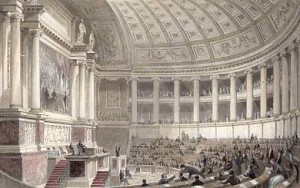
At home, Guizot tried to build up a real conservative party in the Chamber of Deputies, inspired by the English model, on which he could rely firmly. For a long time his majority was short and unstable, and to consolidate it he distributed favours and seats, for which he was strongly criticised. Only the elections of 1846 gave the cabinet full satisfaction, but it is true that more than a third of the deputies were civil servants at the time. Above all, Guizot stubbornly refused all proposals for reform aimed at enlarging the electorate by lowering the cens and prohibiting the holding of certain public offices concurrently with the deputation. In his view, the institutions born of the 1830 revolution were still too new to be modified, they were sufficient to satisfy the needs of society, essentially freedom and prosperity, and any reform would encourage the revolutionary spirit that was so difficult to contain. Although it is not certain that he ever uttered the famous phrase «Get rich by working and saving», he certainly would not have disowned it. Increasingly unpopular, the minister, appointed President of the Council on 19 September 1847, was thus locked in a tête-à-tête with a confused majority and an ageing king. Faced with this stalemate, a banqueting campaign launched in July 1847 led, to the surprise of its promoters and indeed almost everyone else, to the Parisian revolution of 24 February 1848 and the establishment of the Republic. Guizot immediately had to going into exile with his family à London. His political life was over, in a spectacular fall that erased the considerable importance of his work, which included raising the working age for children and the general organisation of the railways.
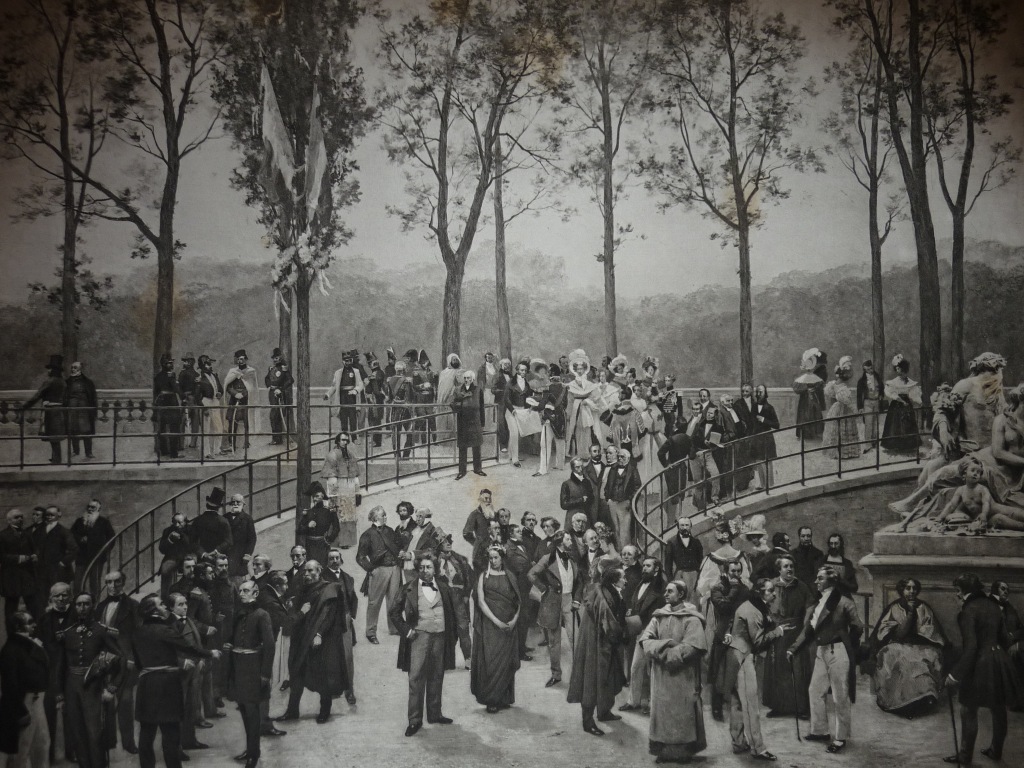
If you click on the image, you can see, among other personalities, François Guizot at the top left of the banister, standing alone.