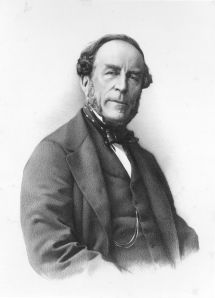
«I am looking for some evil inclination in him. I find none (...) No gap, no cloud». Louis, sometimes called Ludovic, Vitet was for Guizot the model of the ideal companion. Vitet was close at hand at every step, in the big and small things of life, and that is why Guizot, in February 1874, a few months before his death, took the time and overcame the fatigue of old age to write the biographical note that he felt he owed to this perfect friend, the last one left to him, who had died in June 1873. It was also the last substantial text written by him. According to him, they had met in 1819. The grandson of a member of the Convention who was mayor of Lyon, Vitet was seventeen at the time. He was part of a small group of students attached to Théodore Jouffroy, a young philosopher teaching at the École normale and the Collège de Bourbon. It was there that he formed a lifelong friendship with Tanneguy Duchâtel. Although he had not gone very far in his studies, which he did not need in order to make a living, Vitet showed an inquisitive mind and an ability to write that were soon put to good use. After 1820, Guizot recruited him to make the lectures he gave suitable for publication. The creation, in 1824, of the journal Le Globe, the organ of the young liberal France, edited by Jouffroy and his friends, brought him even closer to Guizot, who sponsored the enterprise. Vitet specialised in literature and especially the fine arts, and supported the emergence of Romanticism. From then on, always flanked by Duchâtel, he was associated with all of Guizot's intellectual and political projects. It was he who, in 1827, came up with the name of the society intended to mobilise the opposition electorate, «Aide-toi, le ciel t'aidera», whose manifesto he drafted and over which Guizot presided. In 1828, he was one of the founding members of the French magazine directed by Guizot. The collaborator became a personal friend before 1830. Under the July monarchy, they never left each other's side. As early as October 1830, Guizot, the Minister of the Interior, created for him the post of Inspector General of Historic Monuments, where he was very active, and where Mérimée replaced him in 1834. In fact, his friend Duchâtel, who had been appointed Minister of Trade in April 1834 in the Molé cabinet, called him in as Secretary General of this ministry, which he left with him in February 1836. In September 1834, he was elected deputy for Seine-Inférieure, which he represented without respite until February 1848, while continuing to lead the Commission des monuments historiques, which the Minister of Public Education, Guizot, chaired ex officio. Naturally, Guizot enlisted him in the Société de l'Histoire de France and in the Committee responsible for publishing documents relating to French history. Finally, he joined the Conseil d'Etat in 1836, where he became a pillar of the Finance section. An unwavering supporter of the conservative majority and its leader Guizot, in which Duchâtel, the irremovable Minister of the Interior from 1839 to 1848, held a prominent position, Vitet never became a minister, perhaps because he had little oratorical talent, or perhaps because he himself did not want to, busy as he was with his archaeological research and cultivating a taste for artistic beauty. But his influence was not negligible: «For those in power,» wrote Guizot, "he was an admirably fair-minded, far-sighted and sagacious adviser, rather than an ardent and effective comrade-in-arms". From 18 to 20 February 1848, at the request of Duchâtel, Minister of the Interior, he intervened, but in vain, to prevent the planned banquet from turning into a riot. A deputy to the Legislative Assembly in 1849, in December 1851 he courageously chaired the meeting of deputies at the town hall of the Xth arrondissement, which proclaimed the prince-president's deposition, for which he was imprisoned for a few days.
From then on, and for the next twenty years, Vitet devoted himself to art history, academic sociability - he had been a member of the Académie française since 1845 - and friendship. When Guizot was in Paris, they saw each other two or three times a week, particularly for dinner, and Vitet showed his friend «affectionate care», particularly after the death of Dorothée de Lieven. It is not known why Guizot left small metal boxes containing original letters from the princess at his home, but it was a sign of exceptional trust. Vitet was also one of the few to stay at Val Richer. A regular contributor to the Revue des Deux Mondes, He published no less than eight lengthy and laudatory reviews of Guizot's published works, from his Mémoires to his Méditations sur la religion chrétienne and to French History told to my grandchildren.
Guizot's deep attachment to Vitet was further enhanced by his wife. Cécile Perier, Casimir's niece, had become Mme Vitet in 1832: «In appearance the coldest person, beautiful without movement», in reality «full of passions, spirit, showing all this only to her husband. Never has a man possessed a woman more exclusively, and a woman well worth possessing». It is understandable that Guizot should have sought out her company, while at the same time congratulating himself on this perfect love in a marriage that remained childless. The death of Cécile Vitet in 1858 plunged Louis into despair, for which Guizot sympathised all the more sincerely because he had experienced the same grief twice, and even three times.
In 1871, after publishing some vibrantly patriotic letters, Vitet was elected as a deputy to the Bordeaux assembly, where he joined Cornélis de Witt, Guizot's son-in-law, in the group of liberal conservatives. After the temptation of a moderate Republic, he had time to vote against Thiers in May 1873, a month before his death, as in the heyday of the July Monarchy. His death greatly distressed Guizot: «I have never known a more charming mind without pretension, nor a more reliable character without promise and more dignified with simplicity». Vitet was far from being a genius, but he had the intelligence to recognise Guizot's strength and to feel admiration and affection for him, devoid of the slightest jealousy. More than three hundred letters exchanged between them have been preserved, a striking testimony to this magnificent friendship.