 In mid-March 1807, over lunch with Jean-Baptiste Suard, one of the leaders of the Advertising, Pauline de Meulan, a contributor to the paper, was unable to write due to domestic problems. He wrote to her anonymously, offering to stand in for her, who was living solely off her pen. Eighteen articles appeared in this way, starting on 31 March. They met for the first time on 13 April, and were married five years later at the Oratoire temple and the Madeleine church, as Pauline was of Catholic origin.
François Guizot called her, along with his mother, «the person to whom I owe the most, from whom I have received the most in this world». It is true that Mme Guizot was only nine years older than her daughter-in-law.
Pauline de Meulan was born in 1773 into a liberal and deist military and financial aristocratic family, where the men bore the title of count. Her father Charles, a royal councillor and later Receiver General of Finances in Paris, had married Marguerite de Saint-Chamans in 1762, a woman of higher social standing, who frequented Julie de Lespinasse, the Neckers and Condorcet. Pauline thus grew up under the lights of the eighteenth century.e century. The Revolution and the death of Charles de Meulan in 1790 plunged the countess and her daughters Pauline and Henriette into financial difficulties. Pauline turned to philosophical reading and, with the encouragement of academician Jean-Baptiste Suard, began writing in 1799 to support herself and her family. Novelist, then contributor to Advertising from 1801, she quickly made a name for herself as a woman of head and mind, frequenting the best people of the 18th century tradition.e century.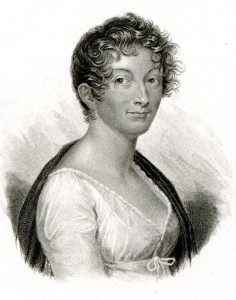 While her brothers Édouard and Théodore enjoyed successful careers, one at the Cour des Comptes and the other in the army, and her sister Henriette married Jacques Dillon, a brilliant engineer, Pauline remained alone. It seems certain that she discovered love with Guizot, a total and overwhelming love for a young man as different from her as possible. «Criticism was levelled at the lady's superior age, and it was said that they had nothing in common, but they loved each other,» wrote a contemporary. In fact, this unusual marriage pleased as much as it intrigued. It was fifteen years of tenderness, passion and fusion. She: «Everything that is best in me has been assimilated into you. He: »You remained the woman you were in yourself by merging your existence with mine. Guizot copied all the countless letters in this ink to make a booklet. After the death of one son at birth in 1813, they had another, François, in August 1815. Pauline was involved in all her husband's intellectual and political endeavours, giving him more than support, and she received his friends warmly. She herself wrote stories for young people, including Schoolboy, or Raoul and Victor was a huge success, as were educational and moral works, including Family letters on education is the best known. His works occupy fifteen columns of the Bibliothèque nationale's catalogue of printed works.
In 1826, Pauline showed the first signs of tuberculosis. On 1er In August 1827, she went into agony, while her husband read Bossuet's sermon on the immortality of the soul: »We parted as late as we could; she lived as long before the grave, I accompanied her there as far as we could. Declaring himself inconsolable, he even began a posthumous correspondence with Pauline. It was from the de Meulan family, to whom he was very attached, that he was soon to find not oblivion but consolation.
Books about Pauline de Meulan-Guizot
2020. Anne Ruolt. Pauline de Meulan-Guizot (1773-1827), a woman of letters and an educator. Raisons, comparaisons, éducations: the French journal of comparative education, L'Harmattan, forthcoming, pp.183-202.