Guizot wrote to his mother in 1808: «I almost never speak to you about my father (...) If you only knew how his memory is always present to me, how I am constantly occupied with him». What memory? He was not yet seven years old when André Guizot died. On the eve of the execution, his uncle took him and his brother Jean-Jacques to the dungeon for a last visit. This scene, in which emotion gave way to fear, became emblematic in the family.
André François Guizot was born in 1766 in Nîmes, into a family of textile merchants with roots going back at least to the 16th century in Saint-Geniès-de-Malgloirès, a few kilometres north-east of Nîmes, where cousins still lived. One of them, very far away, 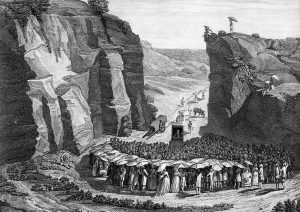 , In 1761, in Nîmes, the pastor Paul Rabaut blessed his marriage to Henriette de Gignoux, herself of Calvinist Cévennes stock. André Guizot never knew his father, who died a few weeks before his birth, and lost his mother when he was fifteen. His brother Pierre Guillaume, three years his senior, was very close to him, however, and was with him right up to his final moments. There is no portrait of André Guizot and very few documents. He must have studied law well, as he was admitted to the bar in 1786. He had already built up a fairly extensive library, typical of a cultivated, open-minded young bourgeois who was sensitive to the zeitgeist. His marriage on 27 December in Nîmes to Élisabeth Sophie Bonicel, blessed by Pastor Gachon, was not legalised until May 1788, at the same time as the birth of their son François, under the Edict of Toleration. Supported at first by his father-in-law, the young lawyer began to prosper in 1791, thanks to his reputation for seriousness and, above all, eloquence. He bought some land, as well as the house in rue Caguensol where he lived with his family. Above all, like his father-in-law Bonicel and a number of Protestant bourgeois from Nîmes, he resolutely supported the Revolution. However, André Guizot, a fiery orator, was an ardent campaigner for the Girondin federalist movement, while Bonicel, Attorney General of the Gard, was a Jacobinist. The Parisian Terror was extended to Nîmes and André Guizot was arrested in October 1793. He remained hidden in his home until 14 January 1794, along with his closest friend Antoine Chabaud-Latour, and then had to flee into the countryside, moving from house to house and finally attempting to reach Geneva. He was found not far from Remoulins, sent back to Nîmes on 6 April and imprisoned. Outlawed and therefore facing the scaffold, he was counting on his father-in-law's influence and his own eloquence to get him off the hook. In fact, all he had to do was answer an identity test and hear the death sentence on the morning of 8 April. He then turned to his judges, most of whom he knew: «I am going to suffer a torment that I have not deserved, but however deplorable my state may be, I prefer it to yours, scoundrels that you are, for in a short time you will be torn apart by the same people who are listening to me». He was guillotined early that afternoon. In his last message to his wife, he wrote his own epitaph: «I may have committed faults, but what man is exempt from them! I dare say I had no vices; I was an honest man, a good citizen, I wanted only the happiness of my country; I was a good friend, a good brother, a good father and a good husband. His son François kept only a few letters from him.