At Saint-Ouen-le-Pin, on the slightly Georgian frame of the school door, a plaque...
GUIZOT SCHOOL
A few years ago, when Olivier Bardot was still the primary school teacher in Saint-Ouen, his classroom had retained its original décor, the same as it had been since 1852, when Mr Guizot offered this spacious house to the municipality to house the school.
Minute of a letter from Mr Guizot to Mr Letavernier, Mayor (8 November 1852)
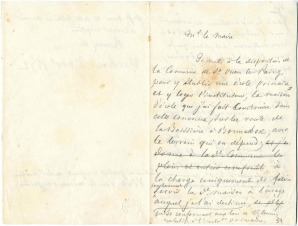
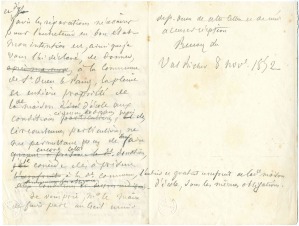
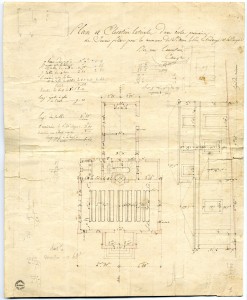
The room resembled a temple, with a sort of orderly, exact simplicity. The teacher «officiated» from behind a high lectern, half pulpit, half luteern, dominating the assembly from a platform with a double staircase... under the autographed portrait - an engraving after Delaroche - of the tutelary and vigilant benefactor. The furnishings: the paintings, like those of the hymns, and the teaching aids were of austere simplicity... the bench-tables looked like stalls. Sealed to the walls like litres were plaques in honour of members of the illustrious family.
Map of Saint-Ouen-le-Pin school
A curious and moving reflection, in the scale of a rural commune, of the Law of 28 June 1833 on Primary Education... the Loi Guizot...
Recall the principles of these texts: obligation for every commune to open a boys' school, to provide the teacher with premises to receive pupils and for his own home. Fixed annual salary of at least 200 francs, with school fees paid in addition by non-indigent parents. Creation of a teacher training college at departmental expense.
Coherent and effective, the July Monarchy owes its greatest and most enduring achievement to Guizot.
There is no doubt a Protestant blend of religiosity, ambition, pragmatism, candour, obstinacy and interest. Protestants have always believed in human capacities and in education as a means of shaping human beings. A religion of the Book, Protestantism favoured knowledge and meditation through reading... A prud'hommesque style? to make reason flourish, to deliver people from jealousy, vanity and fear... and of course! to teach people respect for the law, love of order, redemption through work... For Guizot, the concern is higher, the ideal nobler: to ensure the promotion and happiness of the people...«.« Nothing that does not conform to the precepts of the church or is useful for spreading the word »says the letter above. The pursuit of happiness is « enlightening the soul »It is a way of strengthening them in the fulfilment of their ordinary duties, in the face of the inevitable trials of this world, before the ultimate reward.
Mr Guizot did better: he wanted to explain, convince and help. To all the schoolteachers, isolated in the often hostile and indifferent countryside; ignored and poor sufferers, barely suspecting the existence of their Minister, he addressed personally... For the first time, recognition of their existence and dignity: « Mr.... »
There was nothing in Guizot that was ever petty, small, low, without honesty or faith.
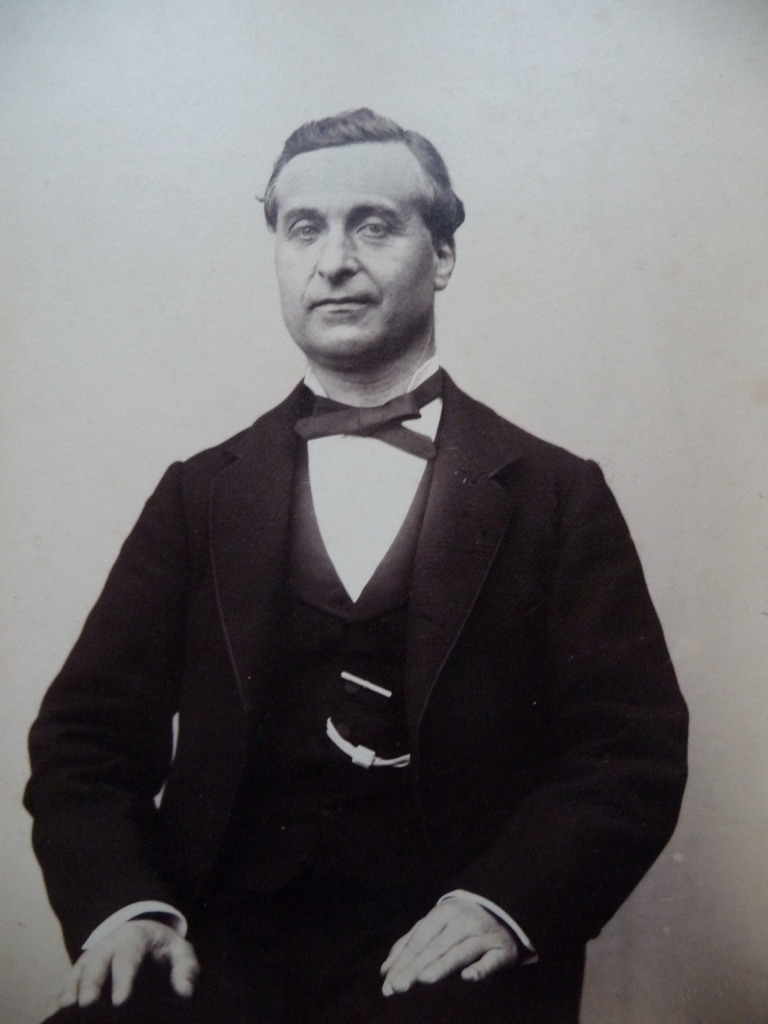
Inscription on the back : Mr Tabourel was the first teacher in St Ouen le Pin. Anonymous, photographic print mounted on card (17.3X16cm) dating from 1850-1860.
«The man tries to transform himself into a bourgeois. He possesses intellectual knowledge and his rather stiff attitude is a visible sign of this; he wants to look good and his watch chain and fine suit are visible signs of this. Guizot had his fur coat, Tabourel his watch chain. Each one displays what he deems to be the most convincing for the image he wants to give of himself». Commentary by Jean Bergeret.
Before Guizot's intervention, the commune was attached to Saint-Aubin-sur-Algot for educational purposes. Mr Tabourel was originally from Port-en-Bessin. « Exemplary Christian »In 1852," writes Canon Simon (The Good Seed, (October 1939): « a tall young man with an intelligent, kind face ». Conscientious and competent, modern and inventive, according to the Annuaire du Calvados (1865): «Teacher Tabourel knows how to quickly introduce shopkeepers to pronunciation and spelling through his successful use of blackboards and movable letters...».»
In January 1867, he married the schoolteacher, sister of the parish priest, in Rusmenil. The mass was celebrated by Abbé Valbrun, the parish priest of Saint-Ouen... Mr Guizot and his family attended the ceremony and, as is customary, added their initials afterwards... The signatures of Guizot, C. De Witt, Guizot de Witt, Pauline de Witt, Robert de W., Jeanne de W. and Pierre de W. can be read, Jeanne de W., Pierre de W. There was a small party at the school, the children offered flowers and sugared almonds were distributed in abundance.
The couple had a son who became a priest and died, towards the end of the Second World War, as the parish priest of Coquainvilliers.
Canon Simon's article did not escape the attention of an illustrious subscriber of The Good Seed, less convinced of the effectiveness of the old teacher's methods: Jean Schlumberger! Which brings us to the most unexpected, amusing and touching praise: « I too was a pupil of that excellent Mr Tabourel, whose memory you are quite right to evoke. He made me draw my first sticks with an archaic pose of the hand and the penholder that made writing almost impossible. During our holidays and his, he came to Val-Richer every morning. He was a very good man. »
P.-J. P
Article from the special issue - Association «Le pays d'Auge», August-September 1987, « M. Guizot and Val-Richer», p63.