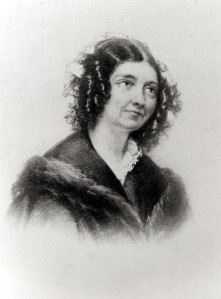
 Achille de Daunant was Guizot's oldest and most loyal friend. With his younger sister, Laure, born in 1790, he forged and developed a relationship of exceptional quality and intensity. The correspondence published in 1934, which spans the period from 1830 to 1864, reveals the full extent of this relationship. Even so, it only concerns his letters, around four hundred of them, and not all of them. Laure's letters were burnt by Guizot at her request, in a procedure that is not uncommon, but which always suggests a desire to erase the expression of an unpublishable intimacy.
Guizot had known her as a young girl in Nîmes, and in 1813 he found her married to Auguste de Gasparin, of Protestant nobility from the Vaucluse, born like himself in 1787, a landowner and agronomist, who became mayor of Orange in 1836, and deputy for the Drôme from 1837 to 1842, with Guizot's support. Under the July Monarchy, François Guizot and Laure de Gasparin, who lived in Orange or at her home in Lacointe in the Gard, saw each other quite often in Paris, where she kept the house of her husband, a member of parliament, and also that of Adrien de Gasparin, her husband's elder brother and widower since 1834 of his elder sister Rosalie de Daunant, Minister of the Interior from 1835 to 1837, and again in 1839.
When did the tender feeling which Guizot's letters, perhaps insufficiently, attest to take shape? In any case, it reached its peak between Guizot's second widowhood in 1833 and the appearance of the Princesse de Lieven in 1837, when he was particularly available. He wrote to her in May 1836: «How many things I do not write to you, and which I would tell you, dear friend! Some too small, others too intimate to be written». And again, a month later, revealing himself as rarely: «In the depths of our hearts there is such an ardent desire for complete abandonment, such a lively pleasure in the absence of all reticence, of all constraint and in the certainty of a reciprocal let-go, that with the woman you love, whom you love completely, who loves you completely, you sometimes give yourself over, with a drive full of charm, to a freedom of thought, of speech, of imagination and of expression which, in any other relationship, would be unbearable and impossible. » We can assume that she responded in kind. They were never so close to each other, although it is not known to what extent. No doubt Guizot's proximity to the Daunant-Gasparin group prevented the relationship from developing to its fullest extent.
The intimacy of heart and mind that united them was surpassed only by that between Guizot and his two wives. With this intelligent, witty, lively woman of assertive character, he was able to express himself completely in the most diverse areas: family life, health, friendships, reading, politics, moods, religion, news and anecdotes. He was never more at ease than with her.
 She herself, it seems, never hesitated to tell him what she really thought, with a vigour he took no offence at, so much esteem and trust outweighed moods and differences of opinion. And they often laughed together. Laure de Gasparin, widowed in 1857 and childless, died on 4 February 1864 in Orange. Thanks to her, Guizot's personality was revealed in all its richness, and she undoubtedly gave him a form of peaceful and strong happiness.