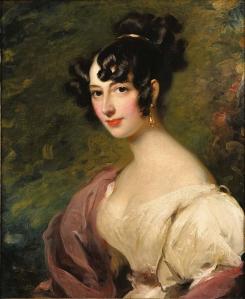
«You're a man, you're strong. I am weak, very weak. I can hardly make myself understood if you have not noticed the pleasure your presence gives me». On 19 March 1837, the Princesse de Lieven wrote to Guizot, words that he was prepared to hear, since three months later he told her «You are no longer alone», thus inaugurating a twenty-year relationship. They were both alone, despite their busy social lives, since Guizot, widowed in 1833, had just seen the death of his eldest son François, and the princess, separated from a husband who was to die in 1839, had lost two young sons aged 14 and 10 in the spring of 1835.
Dorothée de Benckendorff, born in 1784, of Estonian origin and brought up in Saint Petersburg, had married in 1800 the Count, then Prince in 1826, Christophe de Lieven, a Livonian aristocrat whose Tsar Alexander 1er made an ambassador to Berlin in 1810, then to England two years later. Mme de Lieven thus became the very embodiment of the ambassadress, reigning over high society in London and shining in the courts of Europe through her interpersonal skills, her availability and the charm of her conversation. She was the mistress of the Prince of Wales, the future George IV, Metternich, Grand Duke Constantine of Russia and other powerful figures.
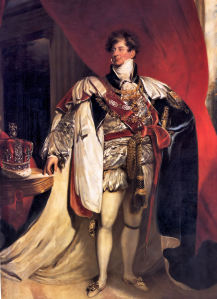
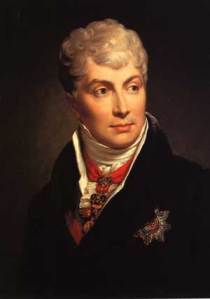
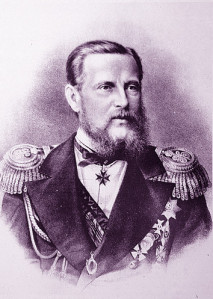
Paying with her body, she believed herself to be a political leader, and made people believe it. By the end of the 1820s, her network of contacts was unrivalled in Europe, even for a woman of her standing. In 1834, the Lievens had to leave the embassy. She settled alone in Paris in September 1835, and was greeted with curiosity by the world at large. Her salon was soon very popular, and she became passionately involved in French politics. «She is a purely political woman», said her friend Lady Granville, wife of the English ambassador in Paris, «she needs people in power. If today we made the executioner President of the Council, she would be delighted to welcome him into her home. She began with Thiers, working hard to make him President of the Council in 1836. But she also had her eye on her rival, François Guizot. They really got to know each other at the beginning of 1836, and exchanged ideas that year, before the revelation of 1837, which seems to have been consummated in the middle of the summer: »30 August was a Sunday,« she wrote to him. Tomorrow will be eight weeks since we solemnly gave ourselves to each other, for this life, for eternity! Farewell, my beloved darling». This affair, which never slackened in intensity despite the increasing age of the partners, and which was publicly displayed, gave rise to a magnificent sentimental as well as political correspondence. When Guizot took up the London embassy in 1840, the princess prepared the way for him and soon joined him. The fact that the Foreign Minister's mistress was a subject of the Tsar of Russia was the talk of the town. Chateaubriand laughed: «A serious doctrinaire has fallen at the feet of Omphale», and a newspaper dressed Guizot as «Sigisbeus of a chancellery deity». It does not seem, however, even if she did not hesitate to give her opinion, that she had any influence on the country's foreign policy choices. The essence of their relationship lay on another level.
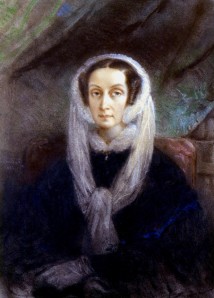
In fact, Dorothée de Lieven remained indefatigably attached to the soon-to-be-retired statesman. They had left for England almost at the same time in 1848, and returned the same way eighteen months later. He continued to frequent and enliven her salon in the rue Saint-Florentin, which regained its lustre under the Second Empire, and where she died on the night of 26-27 January 1857, after having received the pastor Cuvier, as her link with the Lutheran faith had always been maintained. Guizot accompanied her in her very last moments, and her death was a deep wound for him. These two had truly loved each other.
Was it in spite of all that separated them, or because of their very differences? She was an aristocrat, ignorant of anything outside her own milieu, indifferent to the arts except music, with no taste for reading or curiosity about general ideas, with no real friends, hiding her feelings to the point of giving the impression that she was devoid of them, she found in the hard-working, immensely cultured bourgeois, rich in friendships and affections and very sure of himself, a power to which she submitted, while he made her discover, by raising her to his level, personal resources that she had not suspected. While Rémusat saw her as a «great red crane» and Thiers, who was angry with her, as «a talker, a liar and a fool», Barante, on her death, hailed her as «a person of high reason and a noble and sure character». And Guizot himself judged her well: «Her qualities were her own and came from her nature; her faults came from her education and her world.»
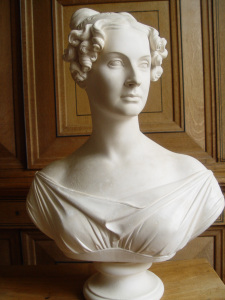
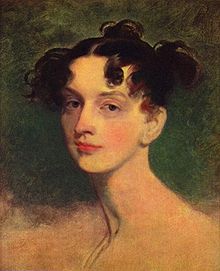
Although they saw each other several times a day in Paris, and wrote to each other almost daily when they were apart, they never lived together, let alone married, as rumour had it. Despite numerous attempts, the princess never managed to break into the family circle, either in Paris or at Val-Richer. Madame Guizot's mother was jealous of her son's monstrous affair, and the children felt it uneasily, although they tried to be polite. She bequeathed him an annuity of 8,000 francs and her car. He wrote her biographical note, declaring: «Truth and trust have constantly reigned in our friendship; it owes its solidity as well as its gentleness to them.» She was buried on the family estate at Mesoten, near Mitau in the Curonian Spit. Her portrait by Thomas Lawrence and her bust by Thomas Campbell, prominently displayed at Val-Richer, show that she had once possessed, if not true beauty, at least elegance and grace.