Monsieur Guizot's retirement
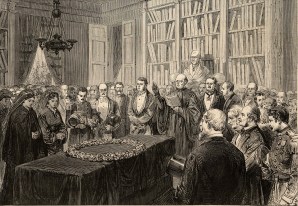
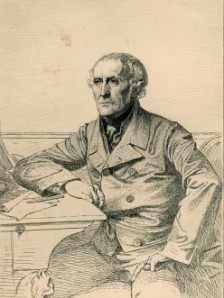 His extraordinary vitality soon got the better of him. The case was dismissed in his favour in November 1848, but he did not return to Paris until the end of the year. Val-Richer in July 1849. In January, he had published a polemical essay with great success, Democracy in France, This contributed to his complete failure in the Calvados elections in May 1849, in his absence. His efforts to bring about a merger between the legitimists and the Orleanists soon proved to be in vain. In 1850 he married his daughters Henriette and Pauline to the brothers Conrad and Cornélis de Witt. He resumed his activities as a historian, completing his monumental History of the English Revolution, then, between 1857 and 1868, publishing the eight volumes of his Memoirs. As the head of a number of learned and religious societies, he exercised a kind of intellectual and moral magistracy that kept him highly notorious and very social, even though he stayed longer and longer at Val-Richer. His male and, above all, female friendships continued to blossom into a magnificent correspondence, much of which has remained unpublished. The only member of the three Academies of the Institut, in January 1861 he received Father Lacordaire under the Dome, where he spoke out in favour of the Pope's temporal power, which deeply disturbed his Protestant co-religionists. Guizot devoted the rest of his life, as active as ever, mainly to religious issues, supporting the small group of liberal Catholics around Montalembert and, within the Reformed Church, the evangelical tendency. In 1870, he obtained the support of the liberal Empire for the convening of a national synod of the Reformed Church of France, the first since 1659, which did not meet until 1872, and in which he played a decisive role.
 Struck by the death of his daughter Pauline in February 1874, he died on 12 September at Val-Richer, He died a beautiful death, surrounded by his family and friends. The response to his death, in France and abroad, was enormous.