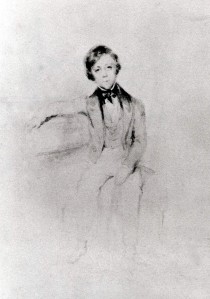
 Two months after the birth of her son William on 11 January 1833, Eliza Dillon died of puerperal fever. The child carried this heavy burden all his life: it had caused the death of his father's beloved wife, his sisters« perfect mother. While birthdays were celebrated actively and tenderly in the family, hers was a day of mourning: »You'll be thirty tomorrow,« her father wrote. What joy! And what pain! In the face of such troubles of the soul, there is only silence. In addition to his deep-seated guilt, Guillaume was overwhelmed by the figure of his brother François, who had died when he was four, the idealized son he should have and could not replace. »My good little Guillaume is my child«, wrote his father shortly after François» death, «but he is not my son. And who knows if he ever will be? Twelve years later, the 16-year-old still thinks about it, when he suggests with infinite delicacy: »I never dared speak to you about my poor brother François; but I know how much tenderness and confidence for the present and the future you had placed in him. It's not his place that I would like to take; the heart, doesn't it? doesn't need to chase away one feeling to admit another«. The father, very touched, didn't understand a thing: the hopes he had pinned on François, »it will be you, my dear child, who will be responsible for realising them". The equivocation never really ended.
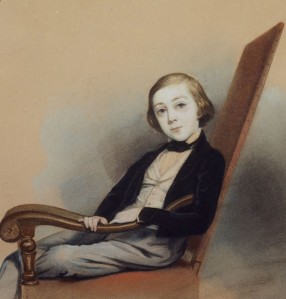 Guillaume was seven years old when Guizot took over the ministry. Despite the protective affection of his sisters and the time their father managed to preserve for his children, he felt the inevitable estrangement. He soon revealed exceptional literary gifts and, as soon as he was admitted to the Collège de Bourbon, he collected successes in general competitions, to the great satisfaction of his father and the whole family. A cordial and charming fellow student, he was the darling of the establishment, including some of the greatest, including Cornélis de Witt and Hippolyte Taine. In February 1848, his whole world collapsed. The easy life of the Boulevard des Capucines was brutally followed by exile and the teenager's reclusion in a small foreign house, alone with his father who acted as his tutor. At least he was able to perfect his knowledge of the English language and literature. Back in Paris at the start of the 1849 academic year, he passed his first year and then his rhetoric classes with flying colours, but above all he became emancipated, with a group of loyal friends, in a boy's life where parties with actresses like Rachel, big cigars and soon gambling, and therefore debts, took on a role that his family, who did not know everything about it, tended to ignore and overestimate. There was no shortage of paternal lectures and exhortations for this amiable boy with a distinguished mind, but who «did next to nothing, and above all without following through». For years, advice rained down on him, and he evaded and dodged, always with this extreme shrewdness of mind: «I would have spoken to you about many things, but for the fear that my father would speak to M. Guizot about them». Although he did indeed talk about many things, in particular literary activities, since Guillaume looked after Guizot's relations, who was increasingly living at Val Richer, with his main publisher Michel Lévy, with whom he became a close friend, and also politics, where he showed himself to be less conservative than his father, he was unable to exchange views with him on Flaubert, whom he admired, George Sand, with whom he corresponded, and Baudelaire, who dedicated one of the very first books to him, The Flowers of Evil, or Wagner, whose premiere of Tannhaüser 13 March 1861: a whole aesthetic universe to which Guizot remained impervious. But Guillaume, alone in the family workshop, produced almost nothing: an essay on Menander in 1853, another on Alfred the Great three years later, and finally a translation of Macaulay's Essays. He never finished his thesis on Montaigne.
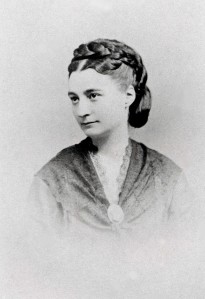
 If work was not a remedy for his costly carelessness, perhaps marriage would fix him. Guizot took the business in hand in 1851, canvassing the daughters of Protestant bankers. Nothing came of it, especially as Guillaume had attachments elsewhere that were unthinkable for his family: «Do you owe it to your family to take your happiness where they dream it for you, and not where you find it?» he wrote to his friend Victor Figarol. Salvation came in the form of Gabrielle Verdier de Flaux, a 20-year-old niece of one of Guizot's childhood friends from Nîmes, who had «a beautiful appearance, a pleasant and distinguished face, strong hair, an intelligent and easygoing air, good manners», wrote Guillaume, who had gone to look for her, and also the hope of a solid fortune. The marriage was celebrated on 26 April 1860 in the main temple in Nîmes by Pastor Jean Monod. This re-establishment of the Guizot name could open the door to the Conseil Général du Gard, but an attempt in 1864 was unsuccessful.
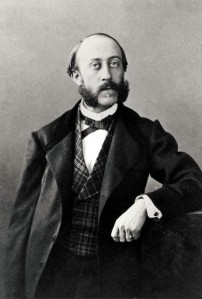
  The marriage itself, although not unhappy because Guillaume showed, here as elsewhere, a great deal of kindness and wit, was not happy either. The couple were too different in culture and temperament, and had no children, much to the chagrin of Guizot, who showed his daughter-in-law a great deal of attention and affection. And Guillaume had not given up all his bachelor habits. Instead of preparing for his lectures at the Collège de France, where he temporarily replaced Louis de Loménie, Amélie Lenormant's son-in-law, he partied, and disaster struck: at the beginning of 1866 it was rumoured that, in order to pay off a gambling debt that was immediately due, he had made a direct request to Napoleon III, who was said to have given him 50,000 francs in gold. Guizot, an opponent of the Empire whose honour was at stake, perceived part of the reality, which Gabrielle revealed to him in tears, even though she did not know everything. «Monsieur Guizot is publishing his memoirs to pay for his son's! Apparently without complaint or reproach, Guizot advances, not without difficulty, the money to extinguish »all the calumnies, all the mad suppositions«, which are less so than he believes or hopes. Let Guillaume at least get to work!
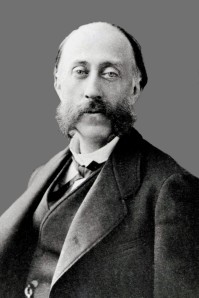 A chair in literature awaited him at the Sorbonne, thanks to Minister Duruy, if at least he agreed to advance his thesis; but no, «the urgency that comes from outside disturbs him more than it pushes him», he had to give up and fall back on a substitute position at the Collège de France, which moreover succeeded well because Guillaume could not do without a great deal of talent. In April 1870, Guizot obtained for him from Émile Ollivier, whom he supported politically, the sub-direction of non-Catholic Cults in the Ministry of Justice. But the embassy in Athens, which had been promised in the summer of 1871 by Thiers, eluded him; no doubt his hyperbolic letters of gratitude to the Emperor had been discovered in the imperial papers. At least Deputy Director Guillaume was responsible for following up the synod of the Reformed Church in 1872, in the preparation and conduct of which his father had played a major role. In 1874, shortly before his death, Guizot was confronted with the public disclosure of Napoleon III's generosity, no doubt at the instigation of the Empress Eugénie. He then intended to reimburse Eugénie in full, selling the Murillo painting that the Queen of Spain had given him in 1846. But her death interrupted the proceedings. In April 1874, Guillaume obtained what he had really wanted, the chair of Germanic languages and literature at the Collège de France, while retaining his post at the Department of Non-Catholic Religious Affairs. Appreciated in literary circles for his erudition and impeccable taste, he seems to have mellowed, making him, if not an excellent husband, at least a much-appreciated uncle to his nephews and nieces, and a much sought-after friend. This personality, seductive because of his gifts but disappointing because of his weaknesses, with a father too big for him, died on 22 November 1892, in the property belonging to his in-laws, near Uzès.