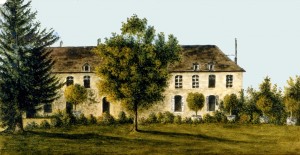
«Tomorrow," wrote Guizot on 11 August 1836 to his daughter Henriette, "I'm going out as soon as I get up to look at a small piece of land three leagues from Lisieux that I've been offered to buy.
The house is a old abbey, There are beautiful woods all around, a spring next to the house, and a strong stream running through the meadows. This land is called Val-Richer.»
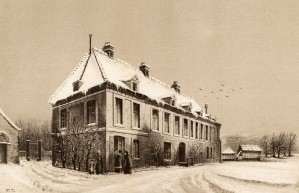 Guizot had been a Member of Parliament for Lisieux since January 1830, but had been slow to settle among his constituents. He also wanted to establish himself on a family estate, where he could stay with his four children, the eldest of whom, François, was 21 years old and would be able to look after them. The estate is located in the Pont-l'Évêque district, the canton of Cambremer and the commune of Saint-Ouen-le-Pin. From the Cistercian abbey founded by Nivard, brother of Saint Bernard, and where Thomas Becket probably stayed in 1170, All that remained was the abbot's dwelling, rebuilt in the mid-18th century, and in fact in a state of disrepair. Guizot bought it, with its 175 hectares of land and woods, for 85,000 francs.
For ten years, with the help of his sister-in-law Aline de Meulan, he devoted much of his modest income to renovating and embellishing the house and garden. He took a keen interest in trees, especially fruit trees, flowers and water features. «In 1840, he wrote: »I would like Val-Richer to become famous for the luxury of its roses and dahlias, and for the excellence of its cherries and apples. Naturally, he devoted all his attention to fitting out his large library in the corridor on the first floor, at the end of which were his study, gradually wallpapered with portraits of loved ones, and his small bedroom of monastic, or Calvinist, asceticism.
The pediment of the inner courtyard bears the motto adopted by Guizot: « Omnium recta brevissima »(the straight path is the shortest of all), which also appears on his ministerial portfolio and which indeed characterises him well. In this bustling solitude, Guizot enjoyed himself: «I spend a good part of my day looking at the nature that surrounds me, and I feel myself becoming as tranquil as it. This is a truly beautiful place, a place of wild, riotous beauty.»
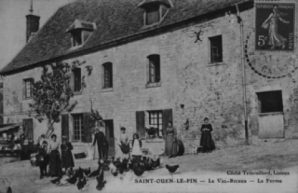 From 1849 onwards, Guizot stayed there more regularly, about half the year, surrounded by a growing family where he practised the art of being a grandfather, while working on his books. In 1855, his daughter Henriette and her husband Conrad de Witt moved in full-time to manage the estate. In 1854, one of the many visitors commented: «This Val-Richer is most pleasant. It is Mr Guizot's retreat according to the rules of the Ideal... A regulated life; a great flow of ideas; friendly, quiet politeness; in short, a charming intellectual oasis in these rather rough valleys of Normandy».»
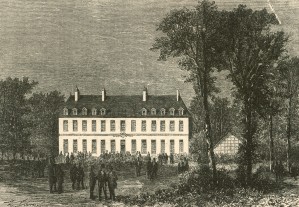
The Val-Richer, whose name is now well known in Parisian and foreign society, has become a focal point for the family rally Guizot's wish. It was here that he died on 12 September 1874, surrounded by his family. He is buried just a stone's throw away, in the family plot in the Saint-Ouen-le-Pin cemetery, surrounded by some of his closest friends.